Shaping the Institute for Child Health: Vision, Strategic Direction and Trajectories 2026 to 2030
Shaping the Institute for Child Health: Vision, Strategic Direction and Trajectories 2026 to 2030
Introduction
This strategy is dedicated to the children and families we serve. They are at the heart of this plan and of our work in research, innovation, education and simulation.
Tionchar: ár gcroí agus ár dtreo
Impact: our heart and our direction
In child health, research, innovation, education and simulation are all life trajectory work, shaping the path a child's life can take. There is no investment in a society with a greater return. The exposures, conditions and stresses of early life carry lifelong and often multi-generational consequences for physical and mental health. Many adult diseases arise from the interplay of biology and environment as children grow. Worldwide, the diseases of infancy and childhood account for the largest share of the total human burden of disease.
When we address harmful exposures, understand and treat childhood disease and relieve the stresses of early life, the benefit to health and to society is profound. Through simulation, we improve both the systems in which care is delivered and the capability of those who provide it, creating safer, more effective healthcare for children and families. Education is central to this mission, enabling current and future healthcare professionals, researchers and leaders to translate knowledge into better outcomes for children and young people. Our task is to set the foundation for wellbeing across the whole lifespan and to support and empower the parents, carers and professionals who set children on their best path.
“We measure our impact by the trajectories we change.
Why Ireland needs ICHI
Ireland already has world-class universities, children's hospitals, research centres and charities. What it has lacked is the connective tissue that joins them. Discovery happens in universities. Care is delivered in hospitals and communities. Innovation emerges from clinical need. Education develops the future workforce. Simulation makes change safe to put into practice. Too often these operate in parallel rather than as one system.
The purpose of the Institute for Child Health Ireland is to be the integrator across these domains. ICHI has not been created to add another research institute, education centre, innovation hub or simulation service. Its purpose is to bring existing strengths together into a single connected ecosystem focused on improving child health outcomes, linking researchers, innovators, educators, simulation specialists, clinicians, policymakers, children, families and communities in a way that no single organisation can achieve alone.
A national endeavour
ICHI has a reach few systems can match. It spans academic child health centres including the INFANT centre in Cork, teams across sixteen universities on the island and child health services in all six health regions and in Northern Ireland. ICHI closely aligns with the core research centres in the Rinn network including Rinn Artificial Intelligence which focuses on data science and ethical AI systems and Rinn Advanced Therapies advancing on personalized immune cell therapeutics for children and adults. It partners with patients and families and their organisations, with community partners and government and with international networks including the European Reference Networks, the European Children's Hospital Organisation and global child health networks. This integrator function is the defining characteristic of ICHI and its greatest strategic opportunity.
Impact: our heart and our direction
Impact is our heart and our direction. Children and families define what impact means, and they are our first partners in creating it. Every study, dataset and collaboration is held to a single test, whether it changes the trajectory of a child's life.
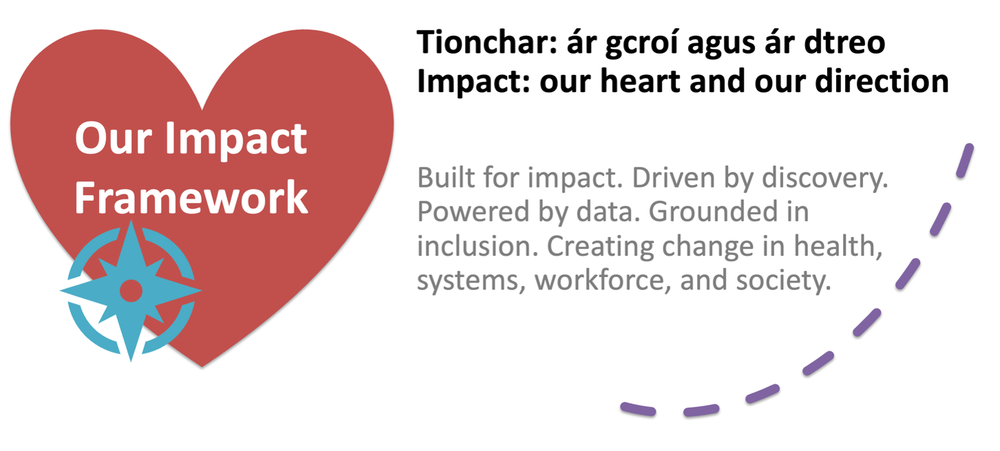
Our work is organised around four connected domains of impact.
Impact
Impact is not a by-product. It is designed, tracked and celebrated. Every initiative maps to one or more of these domains, sets out how its outcomes will be captured and shows how benefit will be shared fairly across all children and families. This creates a continuous loop from discovery to data to delivery, so that impact is measured, sustained and shared. The specific targets and indicators beneath each domain will be set out in the accompanying delivery and measurement plan.
The four engines of impact
ICHI delivers through four mutually reinforcing engines: research, innovation, education and simulation. Each holds distinct expertise, and their greatest strength lies in how they work together.
Together these form a continuous cycle of impact. Research generates knowledge. Innovation turns knowledge into solutions. Education spreads capability. Simulation tests, refines and embeds change in real settings. The insight from implementation and community engagement then shapes the next cycle of discovery.
One integrated plan, four engines at different stages
These engines are at different stages. Research is the most established. The others are building quickly within one integrated plan. Education and academic advancement is integrating 180 Ireland-wide training programmes for the transition to the new National Children's Hospital and developing digital and precision education. ICHI Sim has readied teams for the move to the new hospital and now runs an active 2026 programme across its three areas. Innovation has built a pipeline to support clinical teams and established Europe-wide partnerships to accelerate child health innovation. As their strategies are set over the coming year, each engine will map explicitly to the four impact domains.
Our strategic themes
The Institute provides leadership in areas of strategic priority. These sit where the strengths of our teams, the needs of children and families and the opportunities for partnership and growth meet. Each theme is a child health mission delivered through all four engines, not through research alone.
Ireland 2030: the healthiest country to raise a child
By 2030, Ireland will be recognised as one of the most connected and collaborative child health ecosystems in Europe. Children and families will have faster access to evidence-informed care, more opportunity to take part in research and innovation and services increasingly designed and evaluated with those who use them.
We will have built a nationally connected child health infrastructure that bridges universities, healthcare providers, researchers, educators, innovators and simulation specialists across every region of the island. In that environment, discoveries move more quickly into practice, innovation is co-designed with children, families and professionals, education and workforce development are aligned to future need, simulation is used routinely to improve safety and quality, data is used ethically and securely to improve outcomes and Ireland attracts and retains world-class child health talent.
Through this, ICHI will contribute to better health outcomes, greater research and innovation capacity, stronger workforce development and a more sustainable and learning-oriented health system.
Our impact and value
Impact is the measure of everything we do. Our work turns discovery into tangible benefit for children and families in Ireland and beyond. We hold ourselves to four domains of impact, each setting out the change we work to create and the strength we bring to it.
Clinical trials: the regulated and industry-funded portfolio (August 2026)
ICHI's regulated and industry-funded portfolio comprises 112 trials and studies, led by 37 investigators across 15 paediatric specialties. Of these, 29 are currently open to recruitment and 22 are in follow-up, with a further 39 in set-up and 22 complete. Around three-quarters are regulated trials and roughly two-thirds are industry-sponsored, a mark of Ireland's standing as a credible site for paediatric clinical trials and of sustained partnership with industry. Cancer is the largest single area, with 42 trials, reflecting our strength in precision oncology. More than 1,000 children have been recruited to date across the portfolio, giving Irish children access to advanced and often novel treatment closer to home.
This activity is delivered by a dedicated clinical trials workforce of around 43 whole-time equivalents.
Simulation: the ICHI Sim programme (August 2026)
ICHI Sim works across three areas: education and training (Sim Ed), teams and systems improvement (Culture and Translational Simulation) and capacity building (Faculty Development). The figures below separate completed work from what is planned or estimated for the rest of 2026.
The value of this work reaches well beyond childhood. International evidence is clear that health and development in the earliest years shape lifelong health, education, productivity and wellbeing. Investment in prevention, early intervention and effective treatment in childhood lowers future healthcare use, improves participation in education and employment and strengthens society. Through its integrator role, ICHI increases the return on Ireland's existing investment in child health by connecting effort across the system and reducing duplication. Together this work improves the health of children today, strengthens the system that cares for them, develops the workforce they depend on and delivers lasting benefit to society.
Education and academic development
Education and Academic Development is a core strategic function at CHI, enabling its role as Ireland’s national paediatric service provider and a major centre for the education and development of the future child health workforce. The Department provides the leadership, governance, operational coordination and strategic infrastructure required to deliver education and academic activity across CHI and the NCHI, with a national footprint, and is in partnership with universities, clinical services, regional health areas, professional bodies, educators and learners.
The Department supports undergraduate and postgraduate medical education, nursing and HSCP education, and interprofessional learning, while strengthening academic collaboration, innovation, research and workforce development. Education is integral to CHI’s clinical mission: the workforce we educate and develop today is the workforce that will deliver paediatric care nationally tomorrow and improve outcomes for children and young people.
How we deliver
ICHI grew from decades of partnership. The Research and Innovation Office was established in 2019 and expanded through a mix of core CHI investment and external funding from university partners, industry, the Health Research Board and EU sources. The translational National Children's Research Centre was integrated into CHI in 2024. The academic partnership of CHI and the four Dublin universities was formalised in a Memorandum of Agreement, which established the Paediatric Academic Health Sciences Centre as the academic engine. In 2025 its Board charged the Centre with establishing an all-island Institute for Child Health Ireland and with building the Institute's physical home on the shared St James's campus, the Children’s Research and Innovation Centre (CRIC).
The Institute is overseen by the PAHSC Board, an administrative alliance of Trinity College Dublin, University College Dublin, RCSI University of Medicine and Health Sciences and Dublin City University with CHI. It is led by the Chief Academic Officer. ICHI is organised as a CHI academic directorate with three departments: Research Partnerships and Impact, which carries research, innovation, clinical trials and impact including the CRADLE trusted research environment; Education and Academic Development; and Simulation, which serves culture / teams and systems improvement, education and training, and faculty development. An Executive Director is responsible for governance, advocacy and financial stewardship. In this way the four engines are delivered through three departments, with research and innovation brought together under one directorate. High standards of operational excellence, peer review and transparency are embedded across all our work.
Aligned with the HSE national simulation strategy and interprofessional education priorities
The ICHI Simulation strategy aligns with the HSE National Simulation Office Strategic Plan 2025 – 2028 and the national Requirements to Progress Interprofessional Education in the Clinical Learning Environment (in press) by embedding interprofessional simulation as a driver of safer care, workforce development, team performance and healthcare improvement. Through its integrated focus on simulation-based education, translational simulation and faculty development, ICHI Sim supports national priorities for collaborative practice, psychological safety, quality improvement, patient safety and organisational learning. The strategy contributes to the development of a skilled simulation workforce, sustainable simulation capability and robust evaluation of impact, while positional simulation as both an educational methodology and a strategic tool for testing, improving and transforming healthcare systems. In doing so, ICHI Sim supports CHI’s ambition to be a leader in paediatric simulation and contributes to the wider national vision of embedding simulation within clinical practice, service design and continuous improvement across the Irish healthcare system, contributing to safer, more integrated models of care for children and young people.
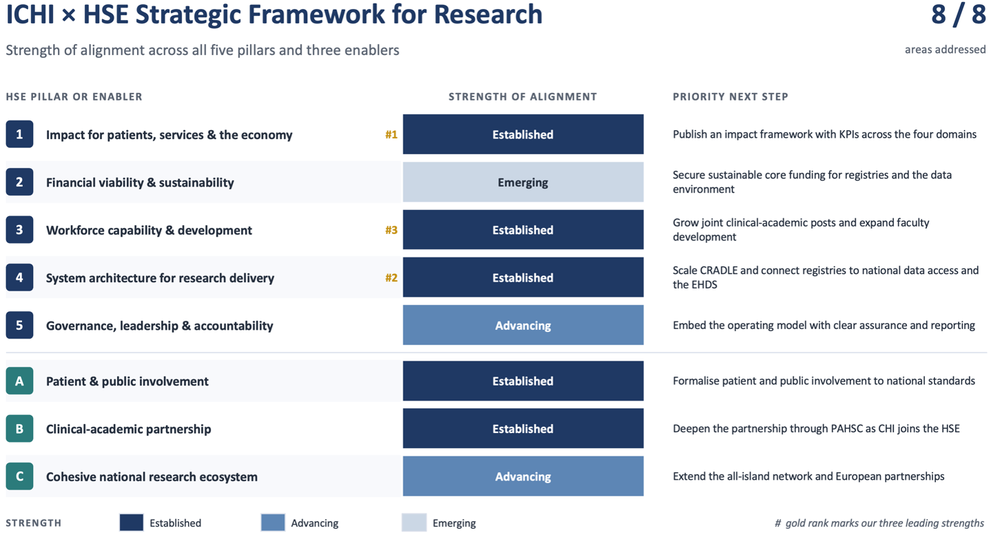
Aligned with the HSE national research framework
As Children's Health Ireland integrates into the HSE, ICHI's direction is set alongside the HSE Strategic Framework for Health and Social Care Research. Alignment is therefore structural rather than optional, and ICHI maps to all five pillars and three enablers of that framework. Built on the clinical-academic partnership that is its foundation, ICHI is the paediatric clinical-academic engine for the HSE's research ambition. Our strongest alignment is on impact; on the data and infrastructure a research-enabled system needs and on workforce development. We are equally clear about the areas we are still building, above all a sustainable funding base for our registries and data environment.
Sustainability
To deliver this strategy we have set seven objectives, each with specific and measurable targets to be confirmed in the delivery and measurement plan:
- Build a strong and inclusive culture and community across research, innovation, education and simulation
- Drive impactful work through our strategic themes and the four engines
- Enable cutting-edge research, innovation, education and simulation
- Equip and develop the next generation of child health leaders
- Partner with children, families, communities and leaders to meet real needs in child health and wellbeing
- Support our teams to achieve national and international impact
- Build a durable framework of funding, infrastructure and governance to sustain the strategy
What we need to succeed
ICHI already aligns across the HSE research framework. To move the areas, we are still building onto the same footing, and to sustain those that are already strong, a small number of things need to be in place.
The most important is a sustainable core funding base for our registries, our data environment and CRADLE, so that national infrastructure is not carried on temporary or philanthropic income alone. Alongside this we need protected time and joint clinical-academic posts to grow the research workforce, continued investment in the Centre for Research and Innovation as the Institute's physical home and a durable partnership with the HSE as Children's Health Ireland integrates into it.
With these in place, ICHI will publish a full impact framework with measurable targets across the four domains, formalise how we involve patients and families, and deliver lasting benefit for every child and family in Ireland.
"Tionchar: ár gcroí agus ár dtreo
Impact: our heart and our direction"